
Takeover Candidate Trading Below Its Subsidiary’s Value
Fabbrica Italiana Lapis ed Affini (BIT: FILA) well-known brands, attractive yields, and acquisition interest underscore hidden value.

It was a good day. I was scrolling through Reuters when I read this:
“Bialetti, the Italian maker of the iconic Moka stovetop coffee pot, is set to be sold to NUO Capital, a Luxembourg-based investment fund.”
“Shares in Bialetti on the Milan exchange surged more than 60%.”
“Aaah, damn it.”
Mr. Baron, how could you let this one slip through your fingers?
I missed the rally. And yet, every morning, I sip my coffee from a humble Bialetti Moka pot. That makes it sting even more.
Now, as penance, I’ll have to comb through the entire Italian market. Humble down. Fire up Refinitiv. Time to find another one. Let’s go.
Summary
This is a vertically integrated, easy-to-understand business with well-known brands, a stake in a subsidiary worth more than its own market cap, a double-digit cash flow yield, ongoing involvement from the founding family, and clear interest from several funds looking to acquire it.
F.I.L.A. Group
Pencils! Crayons! Modelling clay, chalk, oil colours. These are the tools of creativity every child has used and every classroom has seen. If you're from Italy, there's a good chance you've held one of their brands in your hands: Giotto, Tratto, Das, Didò, Pongo. This is what they do, and it's exactly what caught my attention. It's a very easy-to-understand business. From wood to pencil, FILA operates a vertically integrated model that is rare in the sector. It allows the company to maintain full control over every step of production and distribution.
To sum up the story of the company, I’ll borrow this from their website:
“My grandfather’s business started in Florence and arrived in Sicily. My father’s business went from Milan to Sicily. Our business today goes from Shanghai to San Francisco. The USA is currently our first market in the world.”
The above quote brings us to three important considerations.
First, FILA has quietly embedded itself in the daily lives of millions, across generations and continents. Its trademarks are many, its presence international, and its place in consumer memory deeply rooted. The FILA Group is today one of the major players “in the world of colour at a global level”.
Second, this is a business where the family is still involved. I want people who treat the company and the business like they own it because they do. The company is 27% owned by Pencil S.p.A., which, when considering the B shares, holds 53% of the voting rights. Pencil S.p.A. is owned by Massimo Candela, the grandson of FILA’s founder and the current CEO.
Third, a question arises: how did they grow like that? Over the past three decades, FILA has completed 14 strategic acquisitions across Europe, North America, Asia, and India, expanding its global footprint in the art, craft, and education sectors. But there is one subsidiary worth discussing in more detail:
The stake in DOMS
FILA owns a 26 percent stake in DOMS, an Indian publicly listed company, worth about €470 million. Meanwhile, the total market value of FILA itself, including both traded shares and the non-traded B shares, is around €490 million. That means the rest of the company is being valued at close to zero, at least from an equity perspective. And that is exactly when I got really interested.
DOMS is one of India’s leading stationery brands, especially strong in the affordable, mass-market segment, with deep roots in schools, households, and small retailers. They make everything from pencils and crayons to sharpeners, erasers, and notebooks.
On December 20, 2023, DOMS Industries Limited was listed on the National Stock Exchange of India. FILA, which had been the parent company, remained the largest single shareholder, initially holding 30.6 percent of the share capital. A year later in 2024, FILA reduced its stake to 26.01 percent, while still remaining the largest shareholder.
In FILA’s books, this 26.01 percent stake shows up under financial fixed assets, recorded at 139.5 million euro using the equity method. For those less familiar, this accounting method means the stake is carried at historical cost adjusted for earnings and dividends, not at its current market value. So the book value is significantly understated compared to what the stake is actually worth.
Let’s break it down. FILA originally reached a 51 percent stake in DOMS for around €41 million. By the time of the IPO, they had already pocketed around €70 million. After the IPO, they sold another 4.57 percent for €80 million, and the remaining 26 percent is now worth €470 million. All in, that is about €620 million of value created from an initial €41 million in ten years. Congratulations.
At this point, my natural question is: can they monetize this stake? What are their plans for it?
[…] we confirm at the moment to maintain this 26.01% of partnership. We confirm that is the threshold, the 20%. At the moment, we are not in the future program to to reduce our stake in terms of the moment. Because as the agreement confirm, we see the relation with as a very important point for commercial M&A and strategic operation in the future.
So they hold a stake that would make FILA itself practically free, but they have no intention of monetizing it. I’ve always been a strong believer in “Don’t count your chickens before they hatch.” So if they’re choosing to keep it for strategic purposes, my question then becomes: is this stake overpriced?

PE ratios won’t tell you if something is overpriced, but they do show how much growth is already baked into the earnings. Will they grow fast enough to justify a PE of 86? The ROE and ROIC are impressive, and this is India, so maybe. But who knows. Since I tend to be conservative, I’ll be applying a discount when we get to the Value Ramblings section later.
Navigating Uncertainty
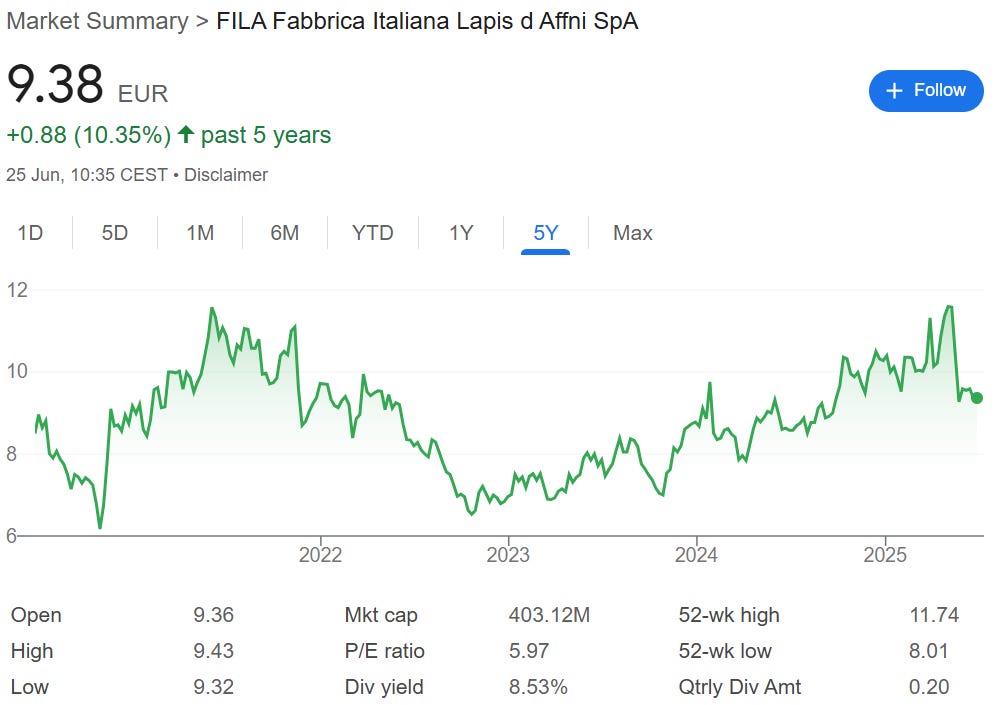
I’m sure you caught this line at the beginning of the article: “The USA is currently our first market in the world.” So, we have to talk about that because it’s a key reason behind the recent drop in FILA’s share price.
First, a bit of context. Two years ago, FILA rolled out a new logistics software system in the United States aimed at improving operating efficiency. The implementation was completed in 2024, but as they admitted, “the learning curve during the first half of 2024 caused slower order fulfillment.” Naturally, this weighed on revenue. Then came macroeconomic uncertainty in the second half of the year, especially fears around potential tariff hikes on goods imported from major exporters like China. Despite that FILA still managed to grow revenues by 4% year over year at constant FX in Q1 2025. North America led that rebound, suggesting that the software rollout issues may now be behind them. So maybe that’s no longer the problem?
What the market doesn’t like is the uncertainty going forward. FILA reaffirmed its guidance for FY2025, but they made a point to say that it could still be adjusted depending on how the tariff situation evolves. This matters, especially for US consumer spending. While FILA is currently seeing solid order levels, many of its customers are in destocking mode, tightening inventory and slowing down replenishment.
Since the end of March signs of weakness have emerged in the US end-consumer market. Management noted that key US customers are under pressure due to the tariff-related uncertainty. In response, FILA has implemented a price increase in the US, which will take full effect on July 1. Depending on how things play out, further price hikes could follow.
So yes, the short-term outlook is softer. But the company expects to maintain solid profitability and stay on the deleveraging path. Let’s not confuse risk with uncertainty. Let’s not forget they’ve been around for 100 years. And let’s not forget: they just told us they have pricing power.
Looking ahead to FY2026, revenue visibility should improve as the tariff situation stabilizes. On top of that, FILA will begin to benefit from its move into the entry-level, low-cost, and private label segments. The DOMS plant will produce these products under the DOMS brand, creating another growth lever.
One last thing to keep in mind: seasonality. This is a real factor, especially for working capital. In the school and office segment, FILA typically ramps up spending from July through September to meet back-to-school demand. But customer payments usually only start coming in around November. It’s worth remembering when looking at interim cash flow figures.
My Value Ramblings
With this company, we actually have the chance to test the products firsthand. I asked my partner, who is a designer, what she thinks of Giotto’s range. She told me they are some of the best non-professional crayons sold in Italy. That stuck with me because, even though I was not much into drawing as a kid, I clearly remember Giotto’s crayons being among my favorites. On top of that, several of FILA’s brands rank among the top sellers on Amazon, which says a lot about their market presence.
Let’s talk numbers now. I always consider both A and B shares. FILA trades at a PE of 11 and a P/B slightly below par. But given what I mentioned earlier about DOMS, these metrics somewhat understate how cheap the company really is.
Now, being conservative and without getting too financially creative, I apply a 30% discount to the DOMS stake at market value, replacing the financial assets currently accounted for at equity value. The equity itself is largely made up of intangibles due to the acquisitions mentioned earlier, which represent a significant portion of the total. So I apply a 30% discount to those as well.
These rough adjustments bring me to about €600M in conservatively valued equity, compared to the current market value of €490M for both A and B shares combined. That represents an appealing discount for a business that generates double-digit free cash flow yields and has returned a cumulative €240M to shareholders since 2020.
Now looking at the valuation from another angle. If we strip out the discounted value of DOMS at market prices and exclude financial assets entirely, and if we assume €45M in net income for 2025, the adjusted PE would be around 6.5.
If I stop being conservative and value the DOMS stake at full market value, then it’s very straightforward, the business would be essentially free, with its only cost being the net bank debt, which stands at €230M. To put that into perspective, FILA generates around €100M in EBITDA and between €40M and €50M in net income.
Strong brands, a solid track record, vertical integration, and an attractive valuation. In the Baron’s mind, yet another final question quietly takes shape: why isn’t anyone trying to pick up this company?
I went on a little adventure through the Italian press, and according to them, at least a couple of funds are interested in investing in a group that has tripled its revenues in just eight years. However, nothing concrete has emerged so far, and no talks have been initiated by Mr. Candela, who is said to have turned down several approaches from both financial and industrial players in the past. Still, industry insiders cannot rule out that these offers might once again be dismissed with ease.
Will they take it private? Who knows. But it’s a quality company, and it’s cheap. To answer that question and keep with the Italian spirit, I’ll borrow their saying:
chi vivrà vedrà!
Sincerely,
The Boredom Baron
Disclaimer:
The content of this article reflects my personal views and is provided for informational and educational purposes only. It does not constitute investment advice, financial advice, or a recommendation to buy or sell any securities or financial instruments.
While I strive for accuracy, the information presented may contain errors or omissions, or be based on sources believed to be reliable but not independently verified. I make no representations or warranties as to the completeness, accuracy, or timeliness of any information presented.
This article is not intended to provide, and should not be relied upon for, investment, legal, tax, or accounting advice. The securities and strategies discussed may not be suitable for all investors. Past performance is not indicative of future results. All investments involve risk, including the potential loss of principal.
I may hold, or have held, positions in the securities mentioned. I do not receive compensation for writing this article, nor do I intend to influence the price or trading volume of any security discussed. All opinions are subject to change without notice.
This content is written strictly in a personal capacity and does not reflect the views of any employer, organization, or associated entity. Readers are strongly encouraged to conduct their own independent research and to consult with a licensed financial advisor before making any investment decisions.
Nice, plus it's down by around 25% lately so a good entry point. Smoak Capital did a great write-up, just FYI https://www.smoakcapital.com/performance
Thanks for the write-up. Couple of questions:
- how does the shareholder structure look like? Is a takeover realistic given the family angle here? I'm on mobile right now, so can't check myself.
- don't you think we should look at tangible book? 30% adjustment to goodwill seems random, think you should take this off.
- Net debt / EBITDA of 2.3x is quite sporty for such a business. Where does this debt come from? What's their target on debt levels?
- How competitive is this market? Any sense of their market share? Who is their fiercest competitor?